Introduction: Infrastructure for Probabilistic Systems
Traditional infrastructure was built for deterministic software: request in, response out, predictable CPU and memory profiles, horizontal scaling when load spikes. You deploy a container, attach a load balancer, and tune autoscaling on CPU or request rate.
AI infrastructure is different. You are operating probabilistic compute — large models that consume GPU memory by the gigabyte, generate output token-by-token, and depend on retrieval pipelines, tool calls, and orchestration layers that did not exist in a typical three-tier web app. The unit economics shift from requests per second to tokens per dollar. The failure modes shift from HTTP 500s to hallucinations, context overflow, and runaway agent loops.
If you lead platform, DevOps, or cloud architecture teams, you do not need to become an ML researcher — but you do need to understand the stack well enough to size clusters, choose cloud vs on-prem, and avoid building expensive prototypes that cannot reach production.
The AI Systems Analogy: Brain, Books, Hands, Nervous System
One useful mental model — popularised in leadership circles as AI acronyms every leader should know — maps modern AI components to parts of a human system. It is not perfect engineering taxonomy, but it is an excellent architecture communication tool when explaining spend and risk to non-specialists.
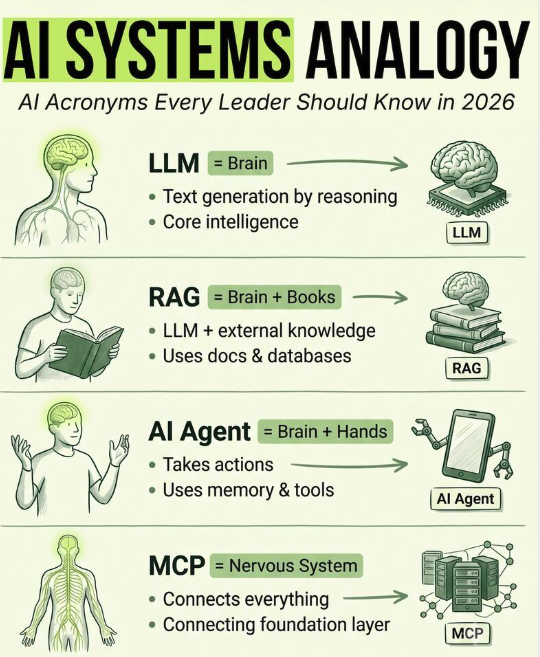
The Brain
Core intelligence. Text generation and reasoning. This is where GPU compute, model weights, inference servers (vLLM, TGI, TensorRT-LLM), and context windows live.
Brain + Books
LLM plus external knowledge. Docs, databases, embeddings, vector search. Grounds answers in your data instead of training data alone.
Brain + Hands
Takes actions. Uses memory, tools, and APIs. Orchestration frameworks (LangGraph, CrewAI), function calling, and sandboxed execution environments.
Nervous System
Connects everything. Model Context Protocol standardises how models discover and invoke tools, data sources, and services — the integration layer between components.
Each layer in the analogy maps to a different bill line and SLO. The Brain is GPU-heavy. Books are storage + indexing + ETL. Hands are API integrations and security boundaries. The Nervous System is networking, auth, and protocol glue. Under-invest in any layer and the system feels “dumb,” “slow,” or “unsafe” — even if the model itself is state of the art.
What Is AI Infrastructure, Technically?
AI infrastructure is the full platform that makes models trainable, servable, observable, and governable in production. It spans:
- Compute — GPUs (NVIDIA H100, A100, L40S, AMD MI300X), TPUs on GCP, CPU fallback for small models and orchestration
- Model serving — Inference engines, batching, quantization (INT8/FP8/AWQ/GPTQ), KV-cache management
- Data & retrieval — Object storage, vector databases (Pinecone, Milvus, pgvector, Weaviate), embedding pipelines
- Orchestration — Agent runtimes, workflow engines, prompt/version management
- Integration — MCP servers, REST/gRPC tool endpoints, event buses
- Platform ops — Kubernetes (often with GPU operators), IaC, CI/CD for models and prompts, cost attribution
- Security & compliance — PII redaction, audit logs, RBAC, data residency, model access controls
- Observability — Token latency, GPU utilisation, RAG hit rate, agent step traces (Langfuse, Arize Phoenix, OpenTelemetry)
A minimal production RAG stack might look like this:
# Simplified production topology

ingress:
  - API Gateway / Ingress (auth, rate limits, WAF)

inference_tier:
  - vLLM or TGI on GPU nodes (HPA on queue depth / GPU util)
  - Model weights on PVC or object storage (S3/GCS) with init containers

retrieval_tier:
  - Embedding service (e.g. bge-large, text-embedding-3-small via API)
  - Vector DB (Milvus / pgvector / OpenSearch k-NN)
  - Document pipeline: S3 → chunker → embedder → index (Airflow / Dagster)

orchestration_tier:
  - LangGraph / custom FastAPI orchestrator
  - Redis for session + short-term memory
  - MCP servers exposing internal APIs (CRM, tickets, runbooks)

observability:
  - Prometheus: gpu_utilization, tokens_per_second, queue_wait_ms
  - Langfuse / OTel: trace_id per user request → retrieve → generate → tool calls
Traditional Infrastructure vs AI Infrastructure
The gap is not “we added a Python microservice.” It is a different resource model, scaling law, and operational surface.
| Dimension | Traditional cloud / DevOps | AI infrastructure |
|---|---|---|
| Primary compute | CPU, burstable instances | GPU / accelerator; VRAM is the bottleneck |
| Scaling unit | Replicas, pods, Lambda concurrency | Model replicas, tensor parallel shards, batch size |
| Latency profile | Milliseconds (p99 < 200ms typical) | Seconds to minutes (TTFT + tokens/sec) |
| State | Mostly stateless; DB externalised | KV cache, context window, agent memory in-process or Redis |
| Cost driver | vCPU-hours, egress, managed DB size | GPU-hours, tokens processed, vector index size, embedding API calls |
| Autoscaling signal | CPU, memory, RPS, queue depth | GPU util, pending requests, batch queue, SLO on TTFT |
| Deployment artefact | Container image + config | Image + model weights (GB–TB) + tokenizer + prompt templates |
| Failure modes | Crash, timeout, data corruption | Above + OOM on VRAM, context truncation, tool misuse, prompt injection |
| Testing | Unit, integration, load tests | + eval harnesses, golden datasets, regression on answer quality |
Teams that treat an LLM endpoint like a stateless REST API often discover three painful truths in production:
- One GPU does not equal one pod. A 70B parameter model may need multiple GPUs with tensor parallelism before it serves a single concurrent session at acceptable latency.
- Autoscaling is slow. Cold-starting a model into VRAM can take minutes. You scale on queued work, not last-second CPU spikes.
- Quality is a non-functional requirement. The service can return HTTP 200 while being wrong. You need evals and human-in-the-loop feedback — infrastructure for quality, not just uptime.
Layer by Layer: What You Actually Operate
1. LLM serving (The Brain)
Inference is the highest-cost, highest-attention layer. Key technical decisions:
- Hosted API vs self-hosted — OpenAI, Anthropic, Bedrock, Vertex AI vs vLLM/TGI on your GPUs
- Model size vs latency — 7B/8B for fast tasks; 70B+ for complex reasoning; mixture-of-experts (Mixtral, DeepSeek) for cost/latency trade-offs
- Quantization — AWQ/GPTQ/FP8 reduces VRAM and increases throughput at some quality cost
- Continuous batching — vLLM’s PagedAttention; critical for GPU utilisation under concurrent users
- Context length — 128K context sounds great until KV-cache memory explodes; infra must cap or tier contexts
apiVersion: apps/v1
kind: Deployment
metadata:
  name: llm-inference
spec:
  replicas: 2
  template:
    spec:
      containers:
        - name: vllm
          image: vllm/vllm-openai:latest
          resources:
            limits:
              nvidia.com/gpu: 1
          args:
            - --model
            - meta-llama/Llama-3.1-8B-Instruct
            - --max-model-len
            - "8192"
            - --gpu-memory-utilization
            - "0.90"
          ports:
            - containerPort: 8000
Metrics that matter: time-to-first-token (TTFT), inter-token latency, tokens/sec per GPU, GPU memory headroom, request queue depth, and cost per 1M tokens.
2. RAG (Brain + Books)
Retrieval-Augmented Generation connects the model to private knowledge without full fine-tunes. Infrastructure components:
- Ingestion — Parse PDFs, HTML, tickets; chunk (512–1024 tokens typical); metadata enrichment
- Embeddings — Batch jobs or streaming; dimensionality (768, 1536, 3072) affects index size and recall
- Vector store — HNSW/IVF indexes; hybrid search (BM25 + vectors) often beats pure vector for enterprise docs
- Retrieval orchestration — Top-k, reranking (cross-encoder), query rewriting, access-control filters per tenant
User query
  → embed query          ~20–80ms   (embedding API or local model)
  → vector search        ~10–50ms   (depends on index size & hardware)
  → rerank top-20        ~50–200ms  (optional cross-encoder)
  → assemble prompt      ~5ms
  → LLM generation       ~2–15s     (dominates; depends on output length)
  → total                often 3–20s wall clock
RAG infra failures are subtle: stale indexes, wrong chunk boundaries, permission leaks across tenants, and “confident wrong answers” when retrieval returns irrelevant chunks. You need retrieval observability — log which chunks were injected and measure hit rate against eval sets.
3. AI agents (Brain + Hands)
Agents loop: plan → call tools → observe → repeat. Infrastructure concerns multiply:
- Tool sandboxing — Agents must not get raw shell on production. Use scoped credentials, approval gates, and network policies.
- State & memory — Short-term (conversation), long-term (vector or SQL memory stores), episodic logs for audit
- Concurrency & timeouts — A single user request may trigger 10+ LLM calls; set max steps and circuit breakers
- Idempotency — Tool calls that mutate state (create ticket, transfer funds) need the same discipline as any distributed system
Without step limits and spend caps, a mis-prompted agent can burn through API quotas or GPU budget in minutes. Treat max_iterations, token budgets, and per-tenant rate limits as first-class platform controls — not application afterthoughts.
4. MCP — Model Context Protocol (Nervous System)
MCP standardises how AI applications connect to data and tools: a host (Claude Desktop, IDE, custom app) talks to MCP servers that expose resources, prompts, and tool definitions over a structured protocol (stdio or SSE).
For platform teams, MCP is the difference between ten bespoke integrations and one connector pattern:
- Internal MCP servers wrap CRM, observability, deployment APIs, runbooks
- Auth flows through your existing SSO / service accounts
- Version and audit tool schemas like any other API surface
Think of MCP as gRPC for agent tooling — not replacing your API gateway, but giving models a consistent way to discover and invoke capabilities safely.
Cloud vs On-Prem: A Technical Decision Framework
There is no universal winner. The right choice depends on data gravity, GPU availability, skill set, and how predictable your workload is.
| Factor | Cloud (AWS/GCP/Azure + managed AI) | On-prem / colo GPU |
|---|---|---|
| CapEx vs OpEx | OpEx; pay per token or GPU-hour | High CapEx; better unit economics at sustained util |
| GPU access | Instant(ish) — if region has quota; H100 queues exist | Lead times on hardware; you own maintenance |
| Data sovereignty | Requires trust + region choice + private endpoints | Strongest control for regulated / air-gapped data |
| Managed services | Bedrock, SageMaker, Vertex AI, Azure OpenAI — fast path | You operate vLLM, drivers, CUDA, firmware, networking |
| Networking | Egress costs when moving TB of embeddings/logs | InfiniBand / NVLink fabrics for multi-GPU training |
| Elasticity | Excellent for spiky dev/test and variable prod | Fixed capacity; scale = buy more racks |
| Break-even | Wins for <~60–70% sustained GPU util or early stage | Often wins at high, steady inference load (rule of thumb) |
Hybrid patterns that work in practice
- Cloud APIs for exploration; self-host for scale — Prototype on Bedrock/OpenAI; move stable workloads to private vLLM when spend crosses a threshold.
- RAG data on-prem, model API in cloud — Sensitive documents never leave your VPC; only retrieved chunks go to the model (with DLP scanning).
- Cloud burst — Baseline GPU fleet on-prem; overflow to cloud GPU pools during peaks (harder to operate, but possible with Kubernetes federation).
- Small models at the edge — Ollama / llama.cpp on CPU for PII-sensitive classification; cloud LLM for heavy reasoning.
# Single H100-class GPU — order-of-magnitude planning numbers
# (Actual $ varies by region, contract, utilisation)

cloud_on_demand:     ~$2–4 / GPU-hour
cloud_reserved_1yr:  ~$1.5–2.5 / GPU-hour
on_prem_amortised:   ~$0.8–1.5 / GPU-hour  (at 80%+ util over 3yr)

# Llama-3.1-8B quantised on 1× H100
throughput:          ~2,000–5,000 output tokens/sec (batching dependent)
# At 1M tokens/day sustained → run the math before you buy vs rent
What Matters in AI Infrastructure (The Short List)
If you are prioritising platform investment, these are the levers that actually move outcomes:
Production priorities
- VRAM and model fit — Can the model run at the context length you need without OOM?
- Throughput under concurrency — Continuous batching beats raw peak TFLOPS on paper.
- Retrieval quality — Bad RAG beats no RAG for wrong answers; invest in chunking, hybrid search, and evals.
- End-to-end latency SLOs — Define TTFT and total response time per use case, not just model benchmarks.
- Cost attribution — Per team, per feature, per token; FinOps for GPUs is mandatory.
- Security boundaries — Prompt injection, tool abuse, data exfiltration via agents — treat as production security.
- Observability with traces — One trace ID from user click through retrieve, generate, and each tool call.
- Governance — Model/version registry, prompt versioning, approval for production prompt changes.
Kubernetes remains the default — with GPU operators
Most teams still land on Kubernetes for AI workloads: NVIDIA GPU Operator, device plugins, MIG partitioning on A100/H100, Karpenter or cluster autoscaler with GPU-aware node pools, and Argo CD for GitOps on model configs. Helm charts for vLLM, Milvus, and Langfuse are mature enough for production if you already run K8s for the rest of the stack.
Observability stack for AI
- Infra metrics — DCGM exporter → Prometheus (GPU util, memory, temperature, power)
- LLM metrics — tokens in/out, latency histograms, error rate by model version
- Quality metrics — automated eval scores, user thumbs, retrieval precision@k
- Tracing — OpenTelemetry + Langfuse/Arize for prompt/response logging with PII policies
Where Traditional DevOps Skills Still Apply — and Where They Do Not
Still applies: IaC (Terraform), CI/CD, secrets management, network policies, incident response, SLOs, cost optimisation discipline, multi-region failover for the control plane.
Needs extension: GPU scheduling, model artefact lifecycle, eval-driven releases, retrieval index versioning, agent safety guardrails, and negotiating with finance on token budgets instead of only EC2 line items.
From building production systems like MeterMate — where AI-assisted fraud detection sits alongside blockchain infra — the lesson is the same: the model is one component in a system that must be deployed, monitored, and cost-managed like anything else. The analogy (brain, books, hands, nervous system) is a useful map; the engineering is still queues, GPUs, indexes, and clear failure boundaries.
Conclusion
AI infrastructure is not traditional cloud with a chatbot bolted on. It is a stack of specialised layers — inference compute, retrieval, agent orchestration, and integration protocols like MCP — each with its own scaling laws, cost drivers, and failure modes.
Leaders who understand the analogy can communicate strategy. Platform engineers who understand GPUs, RAG pipelines, and agent guardrails can deliver systems that survive contact with production — whether you run on Bedrock today or your own H100 cluster tomorrow.
Designing AI platform strategy, RAG architecture, or cloud vs on-prem GPU economics? Consultancy or get in touch — I help teams move from pilot to production without the hype tax.